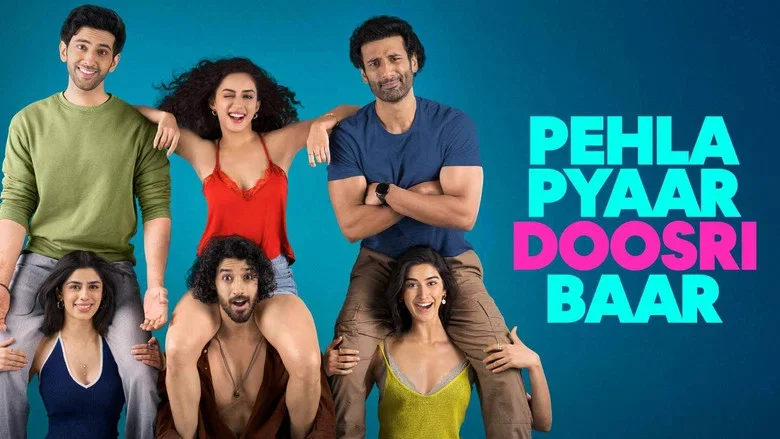
Pehla Pyaar Doosri Baar (2026): Sparsh Walia & Sargun Kaur Luthra in a Reunion Rom-Com That Never Quite Sparks


Ten years after graduation, six friends return to the same rented villa to confess the crushes they never voiced. The premise is sturdy; the pulse is faint.
Anuj Saini’s debut opens on familiar ground, a reunion built on nostalgia, cheap beer and the unspoken arithmetic of who liked whom in Class Twelve. What follows is a romantic comedy that keeps reaching for a spark it can never quite hold.
A Reunion Premise That Arrives Already Exhausted
The film’s first thirty minutes move efficiently enough. Old photographs, shared jokes, the awkward recalibration of adult bodies against school memories, all of it lands with a certain surface competence.
But the screenplay, co-written under Luv Ranjan’s production banner, treats the first-crush premise as an engine that runs on its own momentum. It doesn’t. Familiarity here is not warmth; it’s inertia.
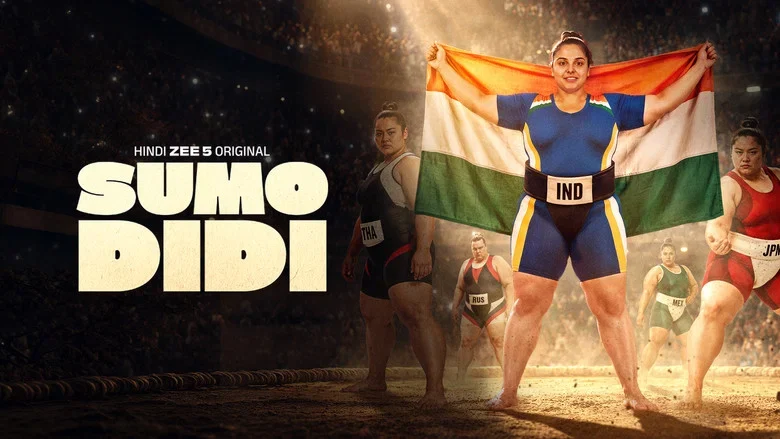
Just as the filmmaker behind Sumo Didi mistook sincerity for structure, Saini mistakes a relatable setup for a working one. The reunion happens. The feelings resurface. The complications multiply. None of it acquires the pressure of genuine drama.
When Friendship Is The Only Relationship That Breathes
The film’s most specific texture lives in the Shivi-Govind-Vedant triangle, not the romantic one, but the platonic one. Sargun Kaur Luthra’s Shivi lives with two long-time male friends, and their dynamic carries a lived-in ease the rest of the ensemble never matches.
Govind and Vedant help Shivi prepare for a date, coaching her through a makeover with the kind of blunt teasing that only long friendship permits. The scene works because the camera stays close and the dialogue stays loose.
It also exposes the film’s central weakness. Shivi’s characterisation, outspoken, casually profane, resistant to conventional femininity, is underlined through explicit dialogue rather than allowed to emerge through behaviour. The screenplay keeps explaining what the performance should simply embody.
The restrained, watchful quality Sparsh Walia brings to Govind’s protective hovering recalls the emotional withholding of his turn in Udta Teer, but here the script gives him no equivalent pressure to withhold against.
The Makeover Scene And The Comedy Of Over-Explanation
The appearance-preparation sequence has drawn the most discussion, and for instructive reasons. It attempts to stage friendship loyalty, romantic anxiety and gender performance in a single comic beat.
What actually happens on screen is three friends in a bathroom, one curling iron, and a running commentary that tells us exactly what Shivi’s relationship to femininity is supposed to be. The comedy is in the situation; the characterisation is in the subtitles.
Compare the comic gravity Annu Kapoor brought to Uttar Da Puttar, where eccentricity was performed rather than annotated. Here, eccentricity arrives with a footnote.
A Six-Person Ensemble With Two Working Relationships
The remaining debut performers, Alisha Chopra, Sakshi Vaidya, Tushar Chhibber, populate the party sequences and the group banter with adequate energy. They are present. They are not, dramatically speaking, accounted for.
Chhibber appears most memorably in the “Zulmi” party sequence, where music and group movement do the work that dialogue cannot. It’s the one stretch where the film’s youthful ensemble format feels earned rather than assembled.
The supporting cast’s function is largely structural: they create the social density that allows romantic misunderstandings to circulate. But a group comedy needs at least three relationships with distinct internal logic. This one has two, and one of them is platonic.
Direction That Trusts The Room More Than The Script
Saini has an instinct for shared spaces. The villa, the party, the bathroom, these are rooms where people can be observed in proximity, and the camera respects that proximity without fuss.
What the direction lacks is rhythm. Scenes begin, play out and end without the escalation that romantic comedy requires. The film’s visual grammar is clean and unremarkable; its pacing is the problem.
The soundtrack, anchored by “Zulmi, ” provides the energy the screenplay cannot generate on its own. When the music stops, the room goes quiet in ways the film hasn’t earned.
Luv Films And The Reunion Rom-Com’s Commercial Arithmetic
Luv Ranjan and Ankur Garg produce through Luv Films, and the commercial logic here is legible. A six-debut ensemble, a modest villa setting, a party song, a familiar premise, this is a film built to a budget that a decent opening weekend can justify.
But the reunion rom-com has become a crowded lane in contemporary hindi comedys, and audiences have learned to distinguish between films that use nostalgia as texture and films that use it as scaffolding.
The theatrical exhibition market rewards novelty in this genre. A debut director with six debut performers has no bankable anchor to absorb a soft opening, and the film’s inability to generate sustained word-of-mouth momentum is a real commercial liability.
What The Ending Refuses To Resolve
The film’s dramatic resolution turns on whether first-love fantasies can survive contact with adult reality. It’s the right question. The answer it offers is softer than the question deserves.
By the final act, the friendships have been tested, the confessions made, and the pairings sorted. What remains unexamined is the cost, the friendships that don’t survive the sorting, the feelings that don’t get resolved.
Pehla Pyaar Doosri Baar wants to be a film about second chances. It ends up being a film about first chances taken too late, and the difference between those two things is the film it could have been.
The spark it keeps reaching for is there in the Shivi-Govind-Vedant dynamic, in the bathroom scenes and the party sequences and the small brutalities of long friendship. Saini just never trusts that spark to carry the weight of a whole film.