Udta Teer (2026): Ayushmann Khurrana’s Amnesia-Spy Comedy Runs on Dramatic Irony, Not Coherent Escalation


The most interesting thing about Udta Teer happens in the first fifteen minutes, and the film spends the next two hours trying to remember why.
Akash A. Kaushik’s debut hinges on a single, genuinely elegant reversal: a Pakistani operative loses his memory in a blast, wakes up convinced he is an Indian patriot, and gets recruited by the very agencies he was sent to infiltrate.
When Amnesia Becomes a Structural Gimmick Instead of a Character Engine
The opening movement is clean and confident. Bilal enters India on a covert assignment, the blast erases his personal history, and the comedy ignites because his professional reflexes survive intact while the allegiance attached to them has been wiped.
That is a sharp premise, and Kaushik stages it with the right deadpan discipline, letting the audience understand the joke before Bilal does.
The problem arrives once the Indian agencies accept him as an asset. The screenplay treats identity verification as a formality it can simply skip, and the film’s plausibility pressure point becomes impossible to ignore.
By the second act, the reversals begin to operate as a conveyor belt of misunderstandings rather than as escalating moral complications.
What the film wants is the suffocating irony of a man sincerely performing a patriotism he has no memory of earning. What it delivers, in stretches, is a spy farce that mistakes volume for momentum.
Kaushik’s tonal control between action, patriotism, and comedy is genuinely tested across the runtime, and the film does not always pass.
The Two-Track Performance That Holds the Center Together
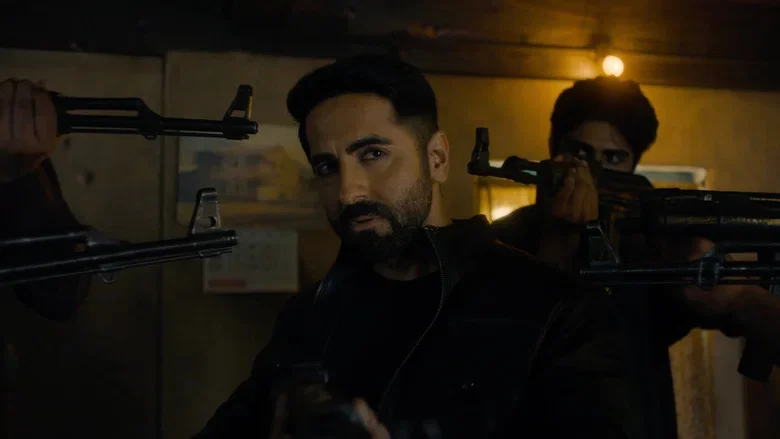
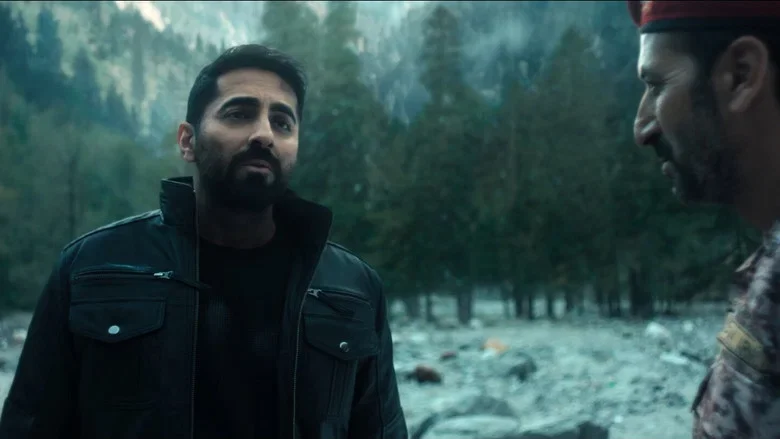
Ayushmann Khurrana is doing something more demanding than the marketing suggests. He has to run two performance tracks simultaneously: the trained operative’s physical confidence and the sincere, almost childlike conviction of a man who believes he is serving the right flag.
Watch his posture in the recruitment sequences. His shoulders sit square, his voice drops into a clipped register, and he looks at his new handlers with the flat, unblinking focus of someone who has never once doubted his own side.
That is the film’s best trick, and Khurrana sells it without winking at the camera.
The dramatic irony is the engine, but it is also the trap. The audience knows Bilal’s true allegiance, so every patriotic declaration lands as a joke, and the film keeps leaning on that joke long after the novelty has worn thin.
There is a version of this performance that could have deepened into something genuinely unsettling, a study of how memory constructs loyalty. Khurrana gestures toward it in the quieter beats, but the screenplay rarely lets him sit in the discomfort.
His work here recalls the psychological weight he carried through the recovery drama of Jeet Ki Zid, where restraint did the heavy lifting. Here the restraint is present, but the material keeps asking him to play the punchline instead of the man.

Sara Ali Khan’s Yamini and the Supporting Ensemble’s Thin Margins
Sara Ali Khan’s Yamini is positioned as the Indian officer who encounters Bilal without knowing his background, and her dramatic function is essentially the audience’s surrogate: professional assessment colliding with information she does not have.
She plays the procedural cool well enough, but the role gives her little room to register the slow suspicion that should define the character’s arc.
The supporting ensemble exists mostly to fill institutional space. Rahul Bose and Ram Kapoor are credited in intelligence and operational roles, but the screenplay does not give either of them a scene that meaningfully tests Bilal or complicates the mission.
Gulshan Grover and Mukul Dev are placed on the opposing network side, and their presence registers as casting texture rather than dramatic opposition.
This is not a cast problem. It is a structural one. The film needs a genuine antagonist who can force Bilal into a confrontation with his own erased history, and it never quite supplies one.
The royal relatives of the spy genre, the handlers and bureaucrats who should apply pressure, remain background furniture.
Where the Direction Finds Its Rhythm and Where It Loses It
Kaushik has a real instinct for the comic geometry of a scene. He stages the post-blast awakening with the right stillness, letting Bilal’s patriotic conviction land before the audience has processed the absurdity of it.
The blast sequence itself is cut tight, with the camera staying close to Bilal’s body rather than pulling back into spectacle, which keeps the film’s scale intimate.
But the film’s visual grammar never develops beyond functional coverage. The covert-operation staging is clean but anonymous, and the action beats are staged with competence rather than personality.
There is no shot here that you will remember a week later, no image that captures the strange tragedy of a man who has lost the war inside his own head.
The film’s closest peer in this respect is the folk-horror comedy of Nayyi Navelli, which also built its premise on a high-concept reversal. That film understood that a gimmick needs a visual language to sustain it. Udta Teer relies on its premise alone.
The second half depends on escalating misunderstandings, agency recruitment, and reversals against Bilal’s former handlers, and the pacing does not so much build as accumulate.
By the time the film reaches its final movement, the surprises have begun to feel like administrative paperwork rather than dramatic revelations.
The Box Office Math Behind a High-Concept Debut
Dharma Productions and Sikhya Entertainment are backing this one, and the pairing is instructive. Karan Johar’s banner brings scale and a mainstream release footprint; Guneet Monga Kapoor’s Sikhya brings the kind of prestige-adjacent credibility that a first-time director needs.
What the film does not have is a clear commercial hook beyond its premise, and the pre-release indicators reflect that.
Advance bookings for opening day were reported at ₹2.59 crore, with opening-day projections in the ₹3–5 crore net range for India. For a film with this cast and this banner backing, those are cautious numbers.
They suggest an audience that is curious but not committed, and a film that will need strong word of mouth to build beyond its opening weekend.
The comparison to the Hindi action space is unavoidable. The theatrical franchise lifecycle of films like Awarapan 2 shows that the genre can sustain sequels and star-driven vehicles, but only when the action delivers a clear, repeatable pleasure.
Udta Teer is not that kind of film. It is a one-off premise in search of a franchise, and the box office will decide whether the gamble was worth it.
Khurrana’s theatrical leverage is real but uneven. He can open a film, but he cannot guarantee a multiplier, and this film’s modest advance numbers suggest that the audience is waiting to hear whether the movie is actually good.
That is the right posture for a film like this, and it is also the most honest one.
The broader landscape of contemporary Hindi action is crowded with films that promise scale and deliver noise. Udta Teer promises a clever idea and delivers a half-realized one, which is both more interesting and more frustrating.
The Uncomfortable Question the Ending Leaves Behind
The film’s final movement turns Bilal against the network he originally served, and the irony is that this is the most conventional thing the screenplay does.
A man who has lost his memory of who he was is forced to become the person his false identity demanded, and the film treats this as a resolution rather than a tragedy.
That is the missed opportunity. The premise contains a genuinely disturbing question: if memory is the only thing that anchors allegiance, then what is patriotism except a story we tell ourselves about who we are?
Udta Teer gestures at that question, then retreats into the safety of a spy comedy that resolves its identity crisis with a punchline.
What remains is a film that is smarter than its execution, carried by a performance that deserved a sharper screenplay. Khurrana holds the center with real discipline, and the premise is strong enough to sustain a better movie.
But a high-concept reversal is not a story, and dramatic irony is not a substitute for dramatic escalation.
The film’s parting thought is unintentional: a man who forgets who he is becomes a hero to the wrong side, and the movie never quite decides whether that is a joke or a tragedy. It plays both, and lands neither.