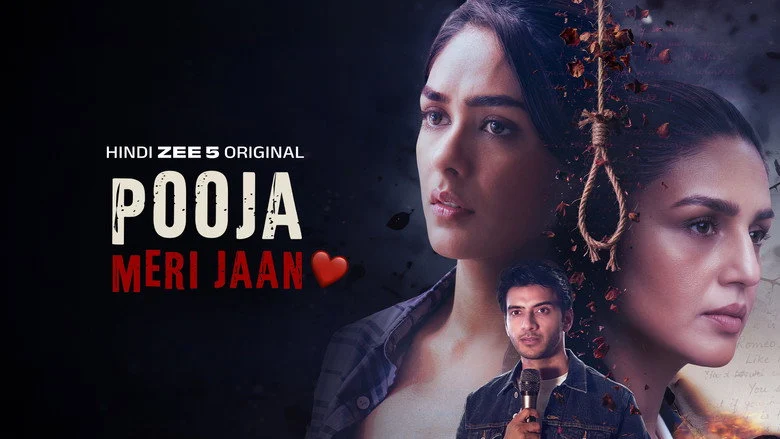
Pooja Meri Jaan (2026): Mrunal Thakur Elevates A Thriller That Never Finds Its Third Act


The most telling thing about Pooja Meri Jaan is not its premise, a woman hounded into legal and social purgatory after a spurned suitor’s suicide, but how quickly the film abandons the woman at its centre. Navjot Gulati’s thriller opens on a stage: a production of Romeo and Juliet, Pooja Dogra (Mrunal Thakur) mid-performance, and Aniket (Vikram Singh Chauhan) waiting in the wings with a confession he has clearly rehearsed to death. She rejects him. He walks away. Then comes the voice note, a message that reframes a private moment of refusal as a public act of cruelty, and Pooja’s life as she knew it is over.
What follows is a film that knows exactly how to set a trap and only vaguely how to spring it. Gulati, working from a script co-written with Kanishka Singh Deo and Niren Bhatt, has assembled a socially charged premise that feels ripped from a thousand comment sections: the woman who says no, and the man who makes her pay for it. It is a story that should feel urgent. Instead, it plays like a film that was made four years ago and has been sitting on a shelf ever since, waiting for a cultural moment that has already moved on.
The Rejection That Refuses To Stay Private
Mrunal Thakur is the reason to watch this film, and she knows it. The early rejection-and-consequence sequence, Aniket’s confession, Pooja’s measured refusal, the immediate aftermath, is the film’s strongest passage, and Thakur plays it with a controlled panic that never tips into melodrama. Her Pooja is not a martyr; she is a woman who did nothing wrong and is being punished for it anyway. The performance is convincing in the way that matters most: you believe her fear, her frustration, and her dawning realisation that the truth is not a defence.
But the film around her starts to wobble almost immediately. The voice note, Aniket’s posthumous accusation, delivered in a tone that is half confession and half indictment, is the film’s structural hinge, and Gulati stages it as a blunt instrument rather than a slow poison. We hear the words. We see the fallout. But we never quite feel the suffocation of a woman trapped by a narrative she cannot control. The film tells us Pooja is being judged; it rarely shows us the texture of that judgment beyond a few scattered scenes of public hostility.
Compare this to the more textured social-thriller work on our desk, the kind of granular character writing that anchors Prem Keetanu review, and the gap becomes clear. Pooja Meri Jaan has the architecture of a good thriller but not the patience to live inside its own tension.
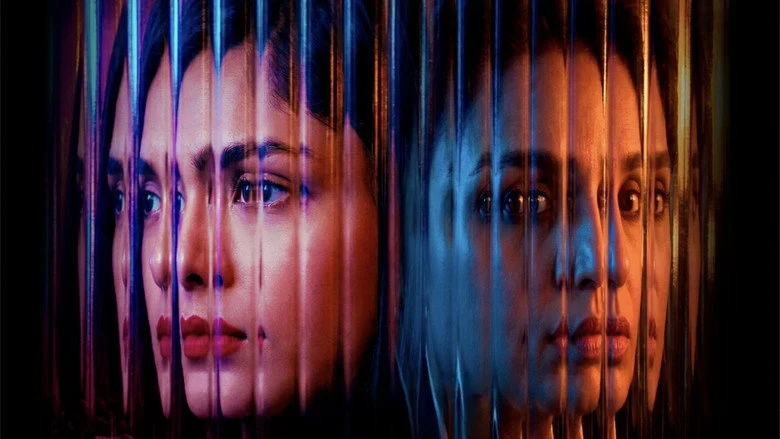
Huma Qureshi’s Sana And The Case That Never Quite Clicks
Huma Qureshi enters as Sana, a lawyer and friend who becomes the film’s investigative conscience. Qureshi is natural, grounded, and entirely believable as a woman trying to piece together conflicting accounts of a death that has already been tried in the court of public opinion. The courtroom-adjacent sequences, Sana sifting through testimonies, cross-referencing timelines, pushing back against the easy narrative, are where the film gestures most explicitly toward procedural thriller territory.
But the procedural elements never cohere into genuine momentum. The film shifts between Pooja’s emotional collapse and Sana’s investigation without ever committing fully to either. The result is a film that feels like two halves of two different movies, neither of which gets the screen time it needs. Vijay Raaz appears in a pivotal role, and his presence is welcome, as always, but the film never gives him enough to do beyond lending gravitas to scenes that need more than gravitas.
The film’s central flaw, as Moneycontrol’s review noted in its truncated but damning assessment, is that it is “neither article”, neither a fully committed issue-driven drama nor a propulsive thriller. It wants to be both. It ends up being neither.

The Obsession Engine And Its Missing Fuel
Where the film does work, intermittently, is in its understanding of obsession as a social performance. Aniket is not a monster in the traditional cinematic sense; he is a man who has convinced himself that his feelings entitle him to reciprocation, and whose final act is not just a suicide but a public accusation. The voice note is not a cry for help; it is a weapon. That is a genuinely unsettling idea, and the film deserves credit for not softening it.
But the execution keeps tripping over its own ambitions. The middle section, Pooja’s arrest, the public judgment, the conflicting accounts, should be a pressure cooker. Instead, it plays like a series of scenes that have been assembled in the correct order but without the connective tissue that would make them feel inevitable. The film’s editing, particularly in the transition from the first-act crisis to the second-act investigation, feels rushed in places and slack in others. There is no single scene that fails catastrophically; there is simply a cumulative sense that the film is not building toward anything.
For a more successful example of a thriller that knows how to sustain its own tension without losing its characters in the process, see our take on Vibe verdict, a film that understands that genre mechanics are only as good as the people caught inside them.
What The Film Gets Right, And Why It Still Isn’t Enough
The performances are the film’s saving grace, and they are not incidental. Mrunal Thakur carries the emotional weight of the film with a commitment that deserves a better screenplay. Huma Qureshi brings a welcome steadiness to a role that could easily have been one-note. Vikram Singh Chauhan, as Aniket, is asked to do most of his work in flashbacks and voiceover, and he manages to suggest a man whose obsession is less about love than about ownership. These are not small achievements.
But a film is not a collection of performances, and Pooja Meri Jaan never finds a way to make its parts add up to a whole. The delayed release, nearly four years between production and premiere, is not just a trivia footnote; it is visible in the film’s seams. The cultural conversation around obsession, consent, and public shaming has evolved considerably in that time, and the film’s treatment of these themes feels less like a provocation than a recitation. It is not that the film is wrong about anything. It is that it has nothing new to say.
As we frequently examine across Hindi Thriller reviews, the difference between a good thriller and a forgettable one is rarely the premise. It is the willingness to stay in the discomfort, to let the audience feel the walls closing in. Pooja Meri Jaan has the walls. It just never lets them close.
Verdict: A Performance-Led Thriller That Loses Its Nerve
Pooja Meri Jaan is a film that should work better than it does. The premise is strong, the cast is committed, and the central conflict, a woman forced to defend herself against a dead man’s accusation, is the kind of story that could have been genuinely unsettling. But Navjot Gulati’s direction lacks the precision to sustain the tension, and the screenplay never finds a way to make its procedural elements feel as urgent as its emotional ones. Mrunal Thakur and Huma Qureshi deserve a better film. So does the audience.
Who should watch it: Devoted fans of Mrunal Thakur and Huma Qureshi, and viewers who appreciate performance-led dramas even when the surrounding film is uneven.
Who should skip it: Anyone looking for a tightly wound thriller or a genuinely provocative take on obsession and blame. The film gestures at both but delivers neither.
Rating: 2.5/5