
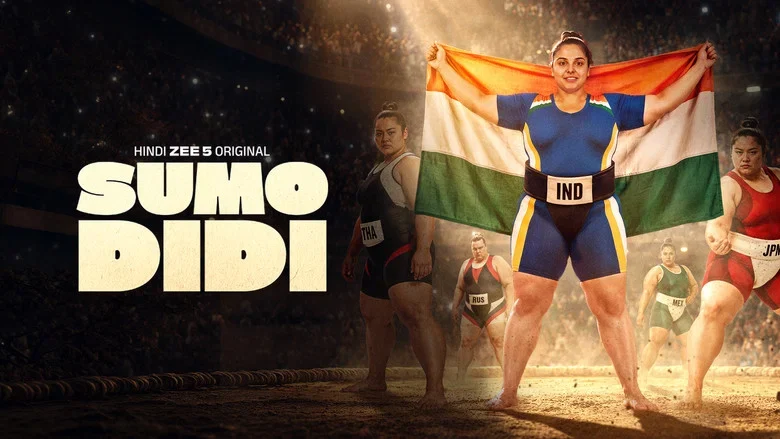
Sumo Didi (2026): Shriyam Bhagnani Anchors A Sincere But Underdeveloped Sports Biopic


The first time Hetal steps into a sumo ring, the camera stops apologizing for her body. Jayant Rohatgi’s film wants that image to land as revelation, and for a moment it does.
What surrounds that moment is a gentler, more frustrating proposition, a biographical sports drama that knows exactly which wound to press but never quite finds the pressure to match.
A Body Reclaimed, But A Story That Stays On The Surface
Sumo Didi opens on the familiar grammar of childhood cruelty, sketching Hetal’s early years as a series of glances, comments, and the quiet arithmetic of a family measuring her worth in kilos.
She is already a state-level judo champion before the film introduces sumo, a detail that matters enormously. It establishes physical discipline before the narrative asks us to admire it.
When Hetal discovers that her build, the same build her mother Sudha begs her to shrink, is a competitive asset, the film briefly crackles with the thrill of a thesis clicking into place.
Then it settles into the well-worn grooves of the genre: humiliation, discovery, resistance, mentor, training montage, validation. The beats arrive on schedule, and the film seems content to let them.

When The Mother Becomes The Antagonist, The Drama Sharpens
Anubha Fatehpuriya’s Sudha is the film’s most effective dramatic instrument, precisely because she is not a villain. She is a mother who believes she is saving her daughter from a life of ridicule.
Watch the way Fatehpuriya delivers the marriage argument, not with cruelty, but with the exhausted certainty of a woman who has run out of other options. It is the film’s most honest confrontation.
Nitesh Pandey’s Rajendra provides a quieter counterweight, a father whose support is expressed through presence rather than declaration. The family unit is internally divided rather than uniformly hostile, and that choice earns the film its best scenes.
Chaitanya Sharma’s Akshat, the physiotherapist turned confidant, functions as the film’s emotional stabilizer, though the screenplay leans on him so heavily for redirection that he occasionally feels less like a character than a narrative device.
Shriyam Bhagnani’s Physical Transformation Carries The Frame
Bhagnani’s work here is built on accumulation rather than eruption. She registers Hetal’s hurt in the set of her shoulders, the way she makes herself smaller in rooms that have already decided she is too large.
Across the training arc, that physical language reverses. Early uncertainty gives way to deliberate movement, and by the ring sequences she projects force through stance and balance rather than dialogue.
It is a performance that understands the difference between being told you are strong and discovering it in your own body. The ring scenes are the clearest evidence of that discovery.
The film’s strongest directorial instinct is to connect the body-shaming to the ring mechanics, the same mass criticized socially becomes an instrument of balance and impact. That is a genuine idea, executed with conviction.
The Journey From Judo To Sumo Deserves More Room Than It Gets
Here is where the film’s compression becomes a liability. The transition from Hetal’s discovery of sumo to her professional breakthrough is handled with a haste that undercuts the enormity of what she is attempting.
The institutional and cultural obstacles surrounding women’s sumo, the marginalization, the financial strain, the absence of infrastructure, are acknowledged rather than dramatized.
The screenplay, credited to Nikhil Sachan from a story by Akash Chawla and Arunava Joy Sengupta, follows a linear path from childhood body-shaming through judo, sumo discovery, training, and recognition, but it rarely pauses to interrogate the strangeness of the journey.
At 114 minutes, the film feels stretched in places and rushed in others, a paradox that suggests a structural problem rather than a pacing one. The story wants to be both intimate family drama and international sports narrative, and it never fully commits to either.
The Ring Sequences Are The Film’s Clearest Claim To Craft
Rohatgi directs the sporting sequences with a functional clarity that serves the material well. The camera stays close enough to register effort, and the ring becomes a space where Hetal’s physicality is finally functional rather than contested.
The visual contrast between the domestic spaces where Hetal is judged and the ring where she is authoritative is the film’s most coherent aesthetic argument. It is not subtle, but it is effective.
What the film lacks is the formal ambition to match its subject’s strangeness. There is no attempt to make the sumo world feel genuinely foreign or forbidding, no sustained engagement with the cultural dislocation of training in Japan.
The film’s treatment of its own premise remains disappointingly conventional, especially when compared to the tonal risks taken in something like Udta Teer, which at least trusted its audience to sit with discomfort.
A Sincere Performance In Search Of A Sharper Film
The supporting ensemble does what it can with limited material. The family dynamics are grounded in recognizable pressures, marriage, body image, parental anxiety, rather than a one-dimensional external villain, and that choice gives the film its most credible texture.
But the screenplay never fully exploits the unusual institutional obstacles surrounding women’s sumo, treating them as backdrop rather than dramatic substance. The result is a film that feels undercooked despite the strength of its subject.
Bhagnani’s commitment is never in question, and there are moments when her physical presence in the ring suggests a tougher, stranger film lurking beneath the familiar surface, one that might have trusted the body more than the biopic template.
The film’s refusal to lean on a conventional villain is admirable, and it aligns with the more patient character work seen in contemporary Hindi dramas like Jeet Ki Zid, which understood that internal conflict can carry a narrative when the writing is precise enough.
Here, the precision is intermittent. The film knows what it wants to say about bodies and worth, but it says it too often and too plainly, as if afraid we might miss the point.
The ZEE5 Release And The Limits Of The Streaming Sports Biopic
Sumo Didi arrives on ZEE5 rather than through a theatrical rollout, and that distribution choice shapes how we should read its commercial ambitions. The film is not built for the big-screen spectacle economy that sustains theatrical sports dramas.
For the streaming platform, the title represents a familiar bet: a recognizable genre, a socially resonant theme, and a lead performance that can be marketed on physical transformation. It is a safe addition to a slate rather than a tentpole.
The broader question is whether the Indian sports biopic can sustain its current volume without evolving its grammar. The genre has become a reliable pipeline, but reliability breeds familiarity, and familiarity breeds fatigue.
Bhagnani’s performance suggests she has the physical commitment for more demanding material. Whether the industry offers her a film that matches that commitment is a separate question.
For a genre that has spent years refining its inspirational register, the next step may be to trust the strangeness of its subjects more than the comfort of its formulas. That is a lesson the wider landscape of contemporary Hindi dramas is still learning.
The film’s final image, Hetal in the ring, her body no longer an apology, is genuinely earned. It is the moment the film has been building toward, and it lands because Bhagnani has done the physical work to make it credible.
What lingers, though, is the sense of a story that deserved a harder, stranger film than the one it received. Sumo Didi is sincere, well-performed, and frustratingly safe, a biopic that celebrates a body without fully trusting the story that body contains.