Dhood (Sandstorm) (2026): Yashpal Sharma Anchors a Thar Desert Pressure Cooker That Refuses Easy Answers


The sand does not move in Anand Singh Chouhan’s Dhood. It sits, it waits, it gets into the seams of every conversation. That stillness is the film’s first and most effective instrument of dread.
An Isolated Household Where Lineage Becomes a Weapon
The premise is deceptively spare: an early-1990s family compound somewhere in the Thar, governed by inherited authority and the anxious demand to preserve bloodline. What Chouhan withholds is the comfort of a clear external enemy.
Every threat lives inside the family’s own walls. The film treats lineage not as heritage but as leverage, something to be hoarded, contested, and ultimately weaponized against the people who share it.
This is a domestic countdown, not a detective procedural. The tension accumulates through the slow recognition that no one in this household is negotiating in good faith.
The Psychological Engine Runs on Greed, Not Gunfire
What makes the middle section hum is the screenplay’s refusal to externalize blame. Greed, power, and desperation are treated as a single interconnected motive, each feeding the others until the family’s preservation instinct curdles into something predatory.
The early-1990s setting matters more than period decoration. Placing this conflict before mobile phones and modern intervention means the household has no escape valve, no outside call, no authority to appeal to, only the grinding pressure of proximity.
That structural choice recalls the claustrophobic patience of Pooja Meri Jaan, another Hindi thriller that understood confinement as a psychological tool rather than a plot convenience.
Yashpal Sharma’s Stillness Manufactures the Film’s Pressure
Sharma has spent decades playing men who carry authority in their shoulders before they speak a word. Here, he strips that authority down to something quieter and more unsettling, a patriarch whose silences land harder than his declarations.
Watch the way he holds a room. He doesn’t gesture. He doesn’t raise his register. He simply occupies space with the unspoken certainty that the room belongs to him, and the family’s nervous glances confirm it.
It’s a performance built on micro-tells, a jaw that tightens before a refusal, eyes that track a relative’s hands rather than their face. The restraint echoes the grounded physicality Sharma brought to Sumo Didi, though here the register is darker and the stakes are blood rather than ambition.
Alka Amin Holds the Emotional Center Without Raising Her Voice
Alka Amin’s presence is the film’s quiet counterweight. She doesn’t compete with Sharma’s gravitational pull; she absorbs it, registering each fracture in the household through a tightening posture and a gaze that keeps calculating the cost.
The supporting ensemble around them, debuting performers whose characters blur into the family’s collective anxiety, serves the pressure chamber rather than distracting from it. If individual arcs feel underdrawn, the ensemble texture still reads as a household genuinely strained.
Chouhan’s Direction Trusts the Desert and the Silence
Chouhan’s camera keeps its distance, letting the desert’s emptiness frame the family’s isolation without editorializing. The blocking favors doorways and thresholds, characters caught mid-crossing, neither fully inside nor out, which quietly reinforces the film’s theme of inherited obligation.
Mehul Surti’s score stays sparse, surfacing only when the silence threatens to become unbearable. The film understands that in a pressure cooker, the whistle is the least interesting sound.
That patience marks a tonal shift worth noting across contemporary Hindi thrillers, which increasingly trust atmosphere over manufactured reversals. It’s a welcome discipline, even when the pacing occasionally tests the viewer’s endurance.
A Regional Milestone With Real Commercial Risk
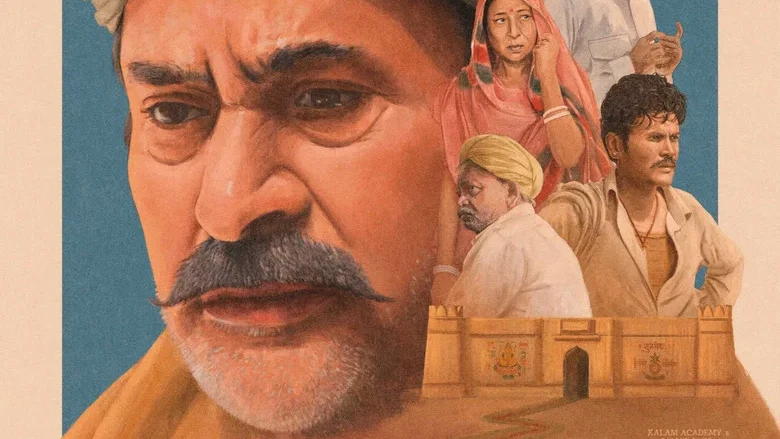
Presented by Kalam Academy and Samar Jain, produced through Soul of Desert Production with Ainak Co-Labs, Dhood carries the weight of being positioned as a first for Rajasthani-language cinema’s pan-India theatrical ambitions.
That’s a genuine commercial gamble. Regional-language films without established franchise hooks or star-driven marketing machinery face brutal exhibition realities, and the producers are betting that a contained psychological drama can travel beyond its linguistic home base.
The film’s theatrical leverage rests almost entirely on Sharma’s recognizability and the novelty of its desert setting. Whether that’s enough to sustain a wide release remains the open question the box office will answer.
The Uncomfortable Resolution and What It Leaves Behind
Chouhan resists the tidy catharsis a family drama might reach for. The ending doesn’t resolve the lineage conflict so much as expose what the demand to preserve it has already cost, leaving the audience with the residue of a household that survived itself but lost something harder to name.
What lingers is the desert’s indifference. The sand doesn’t care who won. That’s the film’s final, quiet cruelty, and its most honest observation about legacy, greed, and the people who mistake control for love.