Nayyi Navelli (2026): Yami Gautam Dhar Anchors a Folk-Horror Comedy That Refuses to Pick a Lane


The new bride reorganises a chaotic Meerut household into gleaming order, and the brother-in-law decides her competence is evidence of the diabolical. Balaji Mohan’s film wants to be a joint-family comedy, a folk-horror mystery and a supernatural reveal machine all at once.
A Daayan in the Kitchen Is a Better Hook Than a Haunted Haveli
The premise earns its keep early. Mohini (Yami Gautam Dhar) arrives in a home ruled by noise, unresolved grudges and kitchen chaos, and quietly imposes order on all of it. That transformation is the film’s smartest invention.
Because domestic improvement doubles as evidence, the same act of competence plays as wish fulfilment and as threat. The family’s relief curdles into suspicion without a single supernatural image being required. It is a genuinely elegant engine.
Where the promotional construction gets cagey is the escalation. The investigation moves from household unease to folk testing, and the whole structure leans on one reveal it refuses to disclose. That reticence is telling rather than tantalising.
The Foot Inspection Is Where Folk Belief Becomes a Comic Ritual
The brother-in-law’s demand that Mohini display her feet is the film’s signature gesture. It invokes the old belief about a witch’s reversed footprint and turns it into a family interrogation. The staging matters: a domestic request made in a shared room, with relatives watching.
That sequence is where the tonal gamble is most visible. Is it a joke about superstition, or the moment the horror curdles? The film apparently wants both readings to coexist, which is a precarious balancing act for a full runtime.
Just as he built tension out of the recovery drama’s refusal to march straight in Jeet Ki Zid, Mohan here withholds the supernatural confirmation and lets suspicion carry the middle act. The difference is that a recovery drama can afford ambiguity; a comedy-horror cannot afford to be coy about its own monster.
Yami Gautam Dhar Plays the Performance of Perfection, Then Drops It
The role is built on a sharp pivot. Mohini first performs warmth, competence and control, and the performance requires Gautam Dhar to make those qualities feel slightly too smooth. Then the reveal flips her into confrontation.
Her advantage is stillness. In the domestic passages she holds a composed physical register, hands busy, face pleasant, eyes tracking who in the room is watching her. That watchfulness is the whole character in miniature.
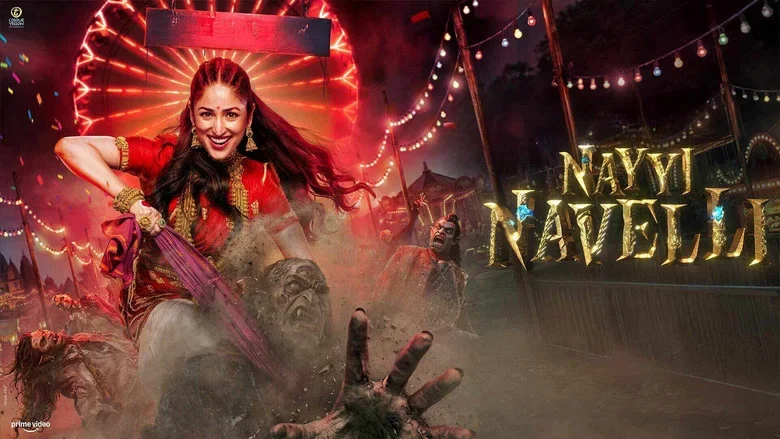
The restrained exhaustion she brings to the reveal recalls the psychological weight of her turn in Poniiy, where she also had to carry a film’s tonal uncertainty on her shoulders. Here she is the film’s central visual pivot, and the marketing knows it.
Around her, the ensemble is largely texture. Mita Vashisht’s Pinky Bua registers as extended-family friction, and Sunita Rajwar’s Asha Devi sits within the household’s reaction apparatus, but neither is given a distinct confrontation. The relatives function as a chorus of suspicion rather than as characters with their own arcs.
Balaji Mohan Builds Suspense From Routines, Not Set Pieces
The direction places the supernatural inside ordinary domestic routine. Conflict arises from cooking, seating arrangements and household behaviour rather than from an isolated haunted location. That choice gives the comedy its oxygen.
The reveal structure is staged with discipline: harmony first, suspicion second, public transformation third. The problem is that this architecture depends entirely on whether the final twist recontextualises the earlier scenes or simply arrives. Without that earned recontextualisation, the third act is a curtain rather than a payoff.
The screenplay, credited to Himanshu Sharma and Divy Nidhi Sharma, runs a linear investigation. No verified plot hole has surfaced, but the central mechanical questions remain unanswered in the marketing: is Mohini genuinely supernatural, and does the family’s transformation have a rational explanation?
The visual contrast between domestic normality and the supernatural reveal is clearly the film’s designed centrepiece, though the specific lighting and framing choices are being kept under wraps. The listed songs, “Bhabhi Tabaahi” and “Phata Patakha, ” signal a deliberately raucous musical register that sits uneasily beside the folk-horror material.
The screenplay resists the kinetic sensationalism that overtook Prahaar, opting instead for a slower domestic dread. That patience is admirable, but patience without a decisive third act is just stalling.
Amazon MGM and Colour Yellow Are Betting on the Family-Horror Hybrid
The producing banners matter here. Amazon MGM Studios and Colour Yellow Productions are staking a theatrical release on a genre hybrid, which is a genuine commercial gamble in a market that rewards clean category signals.
The franchise lifecycle question is whether the daayan-in-the-joint-family premise can sustain a sequel pipeline or whether it is a one-off curiosity. The theatrical exhibition market will decide, and the answer depends on whether family audiences show up for a comedy that turns into a horror film.
Gautam Dhar’s box-office leverage is the other variable. She has become a reliable anchor for tense, mid-budget material, and this film tests whether that reliability extends to a tonal hybrid. As tracked across digital cinema databases and release catalogues like Filmyfly, the reported runtime discrepancy, roughly two hours eighteen minutes in one listing and two hours thirty-eight in another, suggests the final cut is still being negotiated.
This patient character study signals a welcome tonal maturity across contemporary hindi fantasys, proving that tension can thrive without manufactured plot theatrics. Whether audiences reward that maturity is a separate question.
The Reveal Is the Whole Film, and the Film Knows It
Everything in Nayyi Navelli funnels toward Mohini’s public transformation before the family. That is a structurally honest choice: the film’s entire thesis is that a perfect bride is either a blessing or a performance, and the reveal is where the thesis gets tested.
The risk is that the twist becomes the film’s only argument. If the final beat recontextualises the domestic comedy into something darker, the film earns its ambiguity. If it merely shocks, the household comedy was a waiting room.
What lingers is the image of a family that got exactly what it wanted and immediately distrusted it. That is a sharper idea than any daayan, and it is the reason this film is worth arguing about rather than merely watching.