Jeet Ki Zid (2026): Amit Sadh Anchors a Kargil Recovery Drama That Refuses to March in Straight Lines


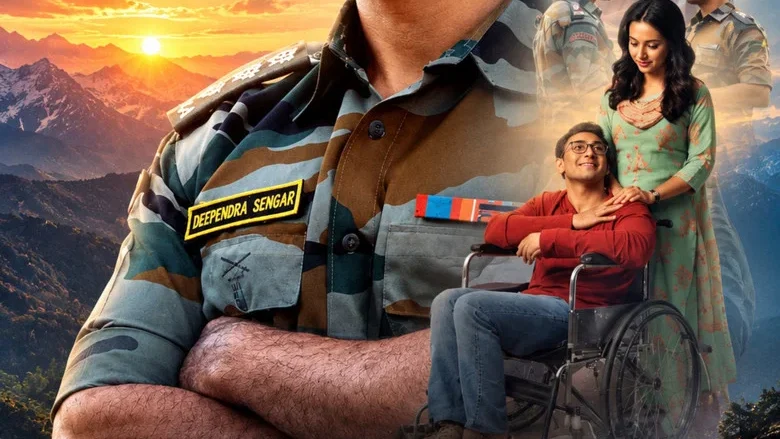
Major Deep Singh loses the use of his legs in the Kargil sector, and the film that bears his name refuses to let him lose the rest of himself quietly. Vishal Mangalorkar’s military drama plants its flag not on the battlefield but in the long, unglamorous aftermath of paralysis.
When the Battlefield Ends, the Real Siege Begins
The opening act establishes Amit Sadh’s Special Forces officer as a man whose identity is fused to his physical capability. The injury arrives as an irreversible rupture, and the film wisely treats it as a structural break rather than a dramatic inconvenience.
What follows is a rehabilitation narrative that relocates suspense from combat survival to the grinding work of reintegration. The screenplay, credited to Akash Chawla and Arunava Joy Sengupta, keeps its gaze fixed on the psychological cost of dependence.
It is a risk-led premise for a Hindi military drama, one that trusts the audience to sit with discomfort rather than reach for triumphalism. The result feels closer to a chamber study of identity collapse than to the flag-waving template the genre usually supplies.
The Antagonist Is a Body That Won’t Cooperate
There is no conventional villain here, and that absence is the film’s most interesting structural gamble. The opposition is paralysis itself, compounded by social expectation and the quiet humiliation of needing help.
Mangalorkar stages this internal siege through spatial diminishment, keeping Sadh’s frame low and hemmed in by furniture, doorways and hospital geometry. The camera rarely grants him the wide, open compositions that defined his earlier military competence.
Where a lesser film would manufacture a snarling officer or a bureaucratic obstacle, this one lets the body and the calendar do the antagonizing. That choice demands patience, and the middle stretch occasionally tests it.
Amrita Puri Holds the Emotional Floor
Amrita Puri’s Jaya is positioned as the principal support figure, and she plays the role with a deliberate refusal of saintly glow. Her caregiving reads as labor, not devotion, and the fatigue in her posture tells its own story.
The film’s interpersonal counterforce lives in these small domestic negotiations, where Jaya’s steadiness meets Deep’s withdrawal. It is the kind of performance that anchors a scene without demanding its spotlight.
Sushant Singh appears in the supporting ranks, though the material gives him limited room to register as anything more than a stern institutional presence. The ensemble around Deep functions largely as texture rather than friction.
Sadh’s Physical Discipline Carries the Middle Stretch
Sadh’s central challenge is communicating collapse and renewed self-belief through a body that has been physically restricted. He works the role through stillness, jaw tension and the slow recalibration of eye contact.
The performance recalls the psychological weight he brought to Prahaar, where restraint did the heavy lifting that dialogue could not. Here, the restriction is literal, and Sadh leans into it rather than fighting it.
His best moments arrive in silence, when the character is alone with the arithmetic of what he has lost. The film trusts those beats, and the actor rewards that trust.
The Pacing Wobbles Where the Plot Should Tighten
The first half moves with purpose, tracing the before-and-after break with a clean chronological spine. The second half, however, risks repetition as rehabilitation scenes cycle through setback and resolve without always escalating.
Mangalorkar’s direction favors a documentary plainness that suits the material, though the film occasionally mistakes endurance for momentum. A tighter edit could have sharpened the emotional throughline without sacrificing its patience.
The biographical foundation, drawn from the real journey of Major Deependra Singh Sengar, gives the recovery arc a weight that fiction alone might not sustain. That authenticity is the film’s sturdiest asset.
It sits in conversation with other recent Hindi dramas that privilege interior struggle over spectacle, much like the devotional restraint examined in Hanuman Ansh. Both trust conviction over crescendo.
The Studio Bet and the Exhibition Question
Bayview Projects, with Boney Kapoor among the producers, is staking capital on a military drama that withholds the catharsis audiences typically expect from the genre. That is a commercial gamble in a market that rewards instant payoff.
The release positioning itself is muddled, with listings split between theatrical and streaming frames, which complicates any read on box-office leverage. For Sadh, the film is a test of whether a character-driven military story can hold attention without a villain to boo.
The broader exhibition climate for contemporary hindi dramas rewards films that convert patience into prestige, and this one is built for that lane rather than the multiplex roar.
The film’s kinship with a peer like Poniiy lies in its willingness to sit with discomfort rather than resolve it prematurely. Both trust the audience to meet them halfway.
A Recovery Narrative That Refuses the Easy Salute
The resolution frames victory as the recovery of agency rather than the restoration of the body, and that distinction is the film’s philosophical spine. Deep does not walk again; he chooses to live again, and the film honors that difference.
It is a quieter, more uncomfortable conclusion than the genre usually permits, and it lingers precisely because it withholds the parade. The final impression is of a man who has made peace with an unfinished body and an unfinished life.
Jeet Ki Zid does not demand your salute. It asks you to sit in the dark with a man learning to move without his legs, and to recognize the siege that never makes the evening news.