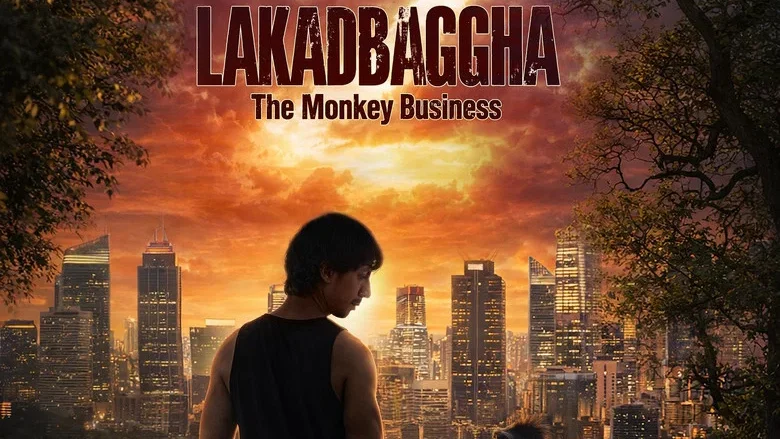
Lakadbaggha 2: The Monkey Business (2026): Anshuman Jha’s Martial Arts Gamble Stalls Before the Bell


The island arrives before the plot does: a wall of West Java green, a man on the wrong side of a tournament bracket, and a fiancée who has vanished into a trafficking network that sells animals and people with the same ledger.
Anshuman Jha returns as Arjun Bakshi, now a vigilante with a passport and a problem the Kolkata streets never taught him.
The Sequel Expands the Map and Misplaces the Compass
The first Lakadbaggha operated on a simple, local engine: one man, one city, one animal rescue at a time. That modesty was its charm.
Here the franchise leaps to an international tournament format, and the leap costs it the street-level intimacy that once made Arjun legible. The island is a gorgeous trap, but it is also a genre trap.
Jha, directing himself for the first time in the series, stages the arrival with a patient wide shot that lets the humidity do the work. Then the screenplay starts handing out exposition like boarding passes.
A Rescue Mission That Keeps Forgetting the Rescue
The missing fiancée is the emotional ignition point, and for roughly twenty minutes the film respects that urgency. Arjun’s search has a jittery, jet-lagged desperation.
Then the tournament swallows the movie whole. Rounds replace investigation, and the trafficking conspiracy becomes a banner hanging over the fights rather than a lived-in criminal ecosystem.
What made Pyre so quietly devastating was its refusal to let a social crisis become wallpaper. This sequel does the opposite: wildlife crime becomes the reason the fights exist, not the reason we care.
By the midpoint, the personal stake and the political stake are running on parallel tracks that never quite touch.
Tony Jha’s Body Does the Work His Script Won’t
Anshuman Jha’s physical commitment is genuine. Watch him in the first tournament bout: shoulders low, breath audible, hands never quite settling into a fighting stance because Arjun is not a martial artist, he is a man improvising.
That detail matters. It is the kind of performance choice that recalls the exhausted, half-broken register he brought to Little Thomas, where stillness did more than dialogue.
But the film keeps asking him to carry scenes opposite performers who exist as silhouettes. Tony Jha shares a corridor with Sunny Pang in a sequence of pure spatial tension, two men measuring each other across ten feet of concrete, and it is the best ninety seconds in the film.
Then the editing cuts away before the confrontation pays off. That is not restraint. That is a structural failure of nerve.
The Antagonist Is a Bureaucracy, and Bureaucracies Don’t Bleed
The trafficking ring is the villain, which is thematically ambitious and dramatically inert. A network has no face, no tell, no micro-expression to read in a close-up.
Adil Hussain appears in a handful of scenes with the calibrated stillness of a man who knows more than he says. His character’s position in the trafficking hierarchy is never clarified, which turns a great actor into a narrative question mark.
When your antagonist is an institution, you need a human proxy who enjoys the cruelty. This film keeps forgetting to provide one.
Jha’s Camera Understands Humidity Better Than Momentum
The visual grammar is the sequel’s real upgrade. Jha and his team shoot the island in long, damp takes, letting sweat and foliage frame the fighters rather than cutting around them.
There is a nighttime sequence where firelight carves the tournament arena into slabs of orange and black, and the staging finally finds the rhythm the script kept promising.
Then the score arrives and flattens it. The background music is mixed loud enough to announce every beat before the image earns it, a habit that Dhood (Sandstorm) avoided by trusting silence to do the heavy lifting.
The second half accelerates into a montage-heavy climax that resolves the trafficking plot in about four minutes of screen time. A conspiracy that took ninety minutes to establish gets dismantled off-screen.
What the Postponement Actually Signals
The shift from a November 2026 slot to early 2027 was framed as a strategic move to avoid a clash and secure a wider release. Read that again with a producer’s eye.
Wider releases cost money, and money follows confidence. A franchise sequel with international martial arts names attached should not need to hide from a calendar.
The producing banners behind this project are betting on the contemporary Hindi thrillers market’s appetite for scale, and viewers following OTT release trackers on mp4moviez know that scale without a clear villain is a marketing problem disguised as an artistic one.
Anshuman Jha’s box-office leverage now rests on whether audiences will follow him from Kolkata’s alleys into a jungle tournament that never quite decides what it is.
The Franchise Needs a Face, Not a Bigger Map
The ending reaffirms Arjun’s protection of animals, which is the right thematic note. But the resolution feels administrative rather than earned.
A sequel should deepen the hero’s wound, not just widen his itinerary. This one widens, and in widening, thins.
The final shot holds on Arjun’s face a beat longer than necessary, as if the film itself is unsure whether it has said anything.
That hesitation is the whole review. Lakadbaggha 2 has the body of a martial arts thriller and the pulse of a franchise still searching for its own antagonist.