

Bandar (2026): Bobby Deol’s Descent Into a Rigged Legal Labyrinth


A fading television star awakens one morning to find his world collapsing, not gradually, but catastrophically. Samar Mehra, once a household name, now inhabits a smaller life with a younger partner, until an allegation arrives like a bomb hidden in a bouquet of flowers. Before he can mount a coherent defense, the arrest comes, the handcuffs follow, and the certainty he once possessed about his own life evaporates entirely.
Anurag Kashyap’s Bandar operates in the register of institutional dread, where the machinery of justice grinds with indifference to truth. This is a film for viewers willing to sit inside a protagonist’s accelerating helplessness, a thriller built not on action beats but on the slow recognition that the system designed to protect you might be the one dismantling you.
Bobby Deol Anchors a Collapse Conducted in Shades of Gray
Bobby Deol delivers the film’s gravitational center by embodying not a hero battling injustice, but a man quietly unraveling as his former status becomes a liability. His Samar is neither entirely sympathetic nor conveniently guilty, he exists in that uncomfortable middle space where vulnerability and culpability coexist without resolution. The opening stretch, which establishes his diminished fame before the accusation reshapes his life, gives Deol room to suggest a man clinging to fragments of his former self, which makes the fall that follows genuinely disorienting.
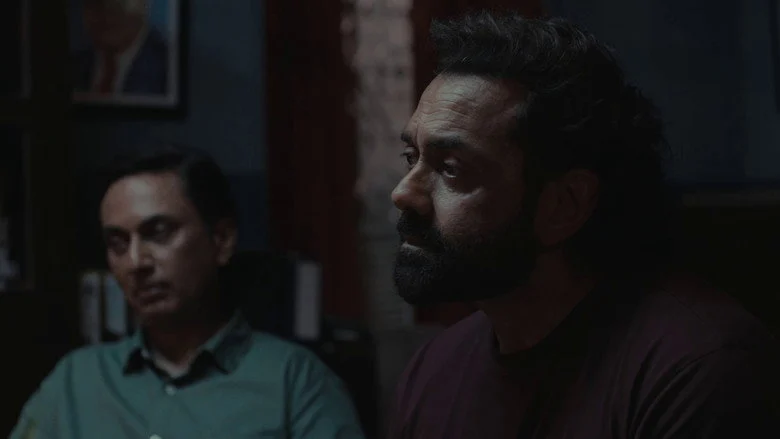
Kashyap’s Direction Builds Systemic Pressure Over Personal Resolution
The filmmaker constructs Bandar as a procedural infiltration into institutional failure rather than a conventional courtroom vindication narrative. His structural choice, pivoting from intimate drama into legal machinery after the arrest-to-custody escalation, sharpens the thematic spine: power systems don’t care about innocence; they consume narrative friction. Where the screenplay occasionally stumbles is in the middle stretch, where the repetition of legal pressure and shifting relationship dynamics risks feeling overly procedural rather than dramatically urgent.

The Thriller’s Machinery Relies on Unstable Truth, Not Spectacular Incident
Where conventional crime thrillers manufacture suspense through violence or revelation, Bandar generates tension through ambiguity. The allegation itself becomes the mechanism, not because it answers questions, but because it destabilizes every certainty Samar possessed about his own narrative. The accusation functions as the film’s central rupture, transforming a domestic drama into an institutional nightmare.
The custody sequences that follow capitalize on this anxiety by refusing easy answers about who is telling the truth. The film’s commitment to murky motivations, examining power, consent, and media perception through a lens that refuses moral clarity, keeps the thriller machinery operational across two hours and sixteen minutes. This approach demands attentiveness; viewers seeking definitive guilt or innocence will find themselves frustrated.
The cast surrounding Deol reinforces the film’s interrogation of contested truth. Sanya Malhotra’s Khushi embodies Samar’s attempt at renewal, making her position in the unfolding crisis genuinely precarious. Saba Azad’s Gayatri, the antagonistic force initiating the allegation, carries the thematic weight of personal history colliding with institutional power, her character’s contested motivations remain deliberately unresolved, which serves the film’s larger argument about how allegations function in systems that rarely prioritize clarity.
Viewers seeking thoughtful crime cinema exploring institutional failure should consider Hindi thriller reviews across this platform for additional perspectives on how the genre continues to evolve.
A Cast Deployed to Reflect Institutional Indifference Rather Than Emotional Catharsis
Sapna Pabbi and Indrajith Sukumaran occupy supporting roles that function more as structural components than fully developed characters, they represent the system’s weight pressing against Samar’s individual agency. This casting strategy signals Kashyap’s thematic priority: institutions matter more than individuals, and supporting players exist to embody that impersonal machinery.
Readers looking for more hindi thriller reviews can explore them on Movies4u.
An ‘A’ Certificate Carries the Film’s Unflinching Treatment Into Its Anatomy
The film’s mature certification reflects its refusal to sanitize its subject matter. Rather than sensationalizing the allegation at the story’s core, Bandar examines how accusations operate as social and legal instruments, often detached from verifiable truth. This analytical distance, neither defending the accused nor vilifying the accuser, positions the film as an intellectual examination rather than an emotional crusade.
Bandar serves audiences comfortable with ambiguity and institutional critique, viewers who accept that thrillers need not resolve with clarity to achieve purpose. The film’s refusal to deliver conventional satisfaction becomes its greatest asset for those attuned to its register and its deepest liability for those seeking narrative closure. Watch this in theatrical format, where the accumulated pressure of Deol’s performance and Kashyap’s procedural construction can accumulate across the full runtime without distraction.
If you appreciated how Star Wars examined institutional continuity over fresh stakes, you’ll recognize Kashyap’s similar commitment to systemic examination over character vindication in this crime thriller.
Bandar is a film that trusts its audience to sit with institutional dread rather than hero’s triumph, a calculated gamble that mostly pays dividends, earning a measured 3.5 out of 5 for its ambitious refusal to comfort.
The same analytical commitment to performance-driven crisis that defines Michael surfaces here, where a single protagonist’s unraveling becomes the film’s entire structural focus.