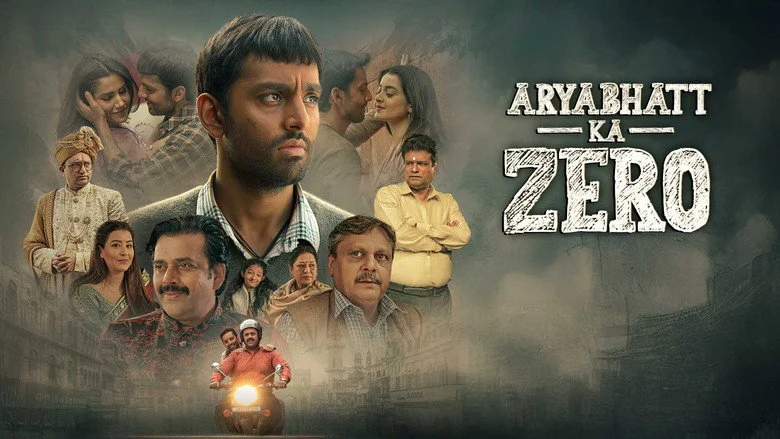
Aryabhatt Ka Zero (2026): A Familiar Zero-To-Hero Fable That Never Adds Up


Baggu sits in his father’s shadow, a young man dismissed as a complete zero before he has even tried to be anything else. Kamal Chandra’s small-town drama wants to chart his climb from that zero to something resembling a hero, but the arithmetic never quite works out.
Himansh Kohli anchors the film with a performance that understands Baggu’s comic awkwardness and his quieter vulnerability. The opening father-son confrontations carry genuine sting, with Neeraj Sood’s dismissive father landing each verbal jab with practised cruelty. Kohli’s best moments arrive when he lets Baggu’s self-doubt flicker beneath the surface instead of playing the underdog card too broadly.
The Father-Son Conflict Is the Film’s Only Real Muscle
When Baggu learns Rinku has been married off to an SDM, the film pivots from romantic disappointment into UPSC preparation mode. That pivot works because the humiliation feels earned, grounded in the small-town Uttarakhand setting that gives the film its modest texture.
But the screenplay, written by Tariq Mohammad, loses its grip once the exam arc takes over. The motivational stretch drags, repeating beats of self-doubt and encouragement until the dramatic build-up feels stretched and uneven. The Hindustan Times review called it “a two-hour long trip to nowhere, ” and that headline captures the structural problem better than any analysis could.
The Drama Works Best When It Stays Small
Kamal Chandra’s direction keeps the film rooted in domestic spaces and modest public environments, which suits the story’s intimate ambitions. The father labeling Baggu as a zero is the film’s sharpest dramatic moment, a single gesture that explains the entire emotional conflict. Chandra understands that this story lives in the family home, not in the exam hall.
Yet the drama never builds enough momentum to justify its 114-minute runtime. The middle section repeats its motivational beats without adding texture, and the familiar underdog-becoming-capable structure feels thinly developed. The film compares poorly to stronger entries in this space like 12th Fail, which earned its emotional payoff through sharper writing and better pacing.
The comedy, meanwhile, stays light and accessible without ever becoming distinctive. The slice-of-life framing keeps things pleasant, but pleasant rarely translates into memorable. The film’s central theme of self-belief and perseverance remains coherent in concept, but the execution never sharpens it into something that cuts deep.
Sonnalli Seygall and the Supporting Ensemble Do Their Jobs Quietly
Sonnalli Seygall’s Rinku functions as the romantic trigger rather than a fully realised character, but she brings enough warmth to make Baggu’s disappointment feel real. Her marriage to Gopal Dutt’s SDM shifts the story into its motivational phase, and Seygall handles the transition with understated grace.
Ravi Kishan appears as part of the ensemble without a clearly isolated subplot, his presence adding weight to the small-town texture. Alka Amin, Rajesh Sharma, and Shilpa Shinde round out the cast, each contributing to the family atmosphere even when the script gives them limited material to work with. The casting signals a film that values character actors over spectacle, which suits its grounded ambitions.
Kohli’s performance carries the emotional core, but even he cannot rescue the film from its own predictability. The audience response on IMDb sits at a surprisingly warm 7.5, suggesting viewers connected with the relatable underdog setup and family emotions despite the pacing complaints. That gap between critical dismissal and audience warmth tells you exactly who this film is for.
For more Hindi drama reviews and similar small-town stories, browse our Hindi Drama reviews section.
A Familiar Fable That Never Finds Its Own Voice
The film’s central conflict, a socially dismissed young man fighting humiliation and self-doubt, is solid dramatic material. But the screenplay handles it with the same predictable beats we have seen in countless underdog dramas, without the sharpness that made similar films like Chhichhore work.
The editing also lets the film down in the second half, where the motivational progression becomes repetitive. The first half sets up the character conflict and romance-driven frustration competently, but the momentum fades once the exam arc takes centre stage. I found myself checking the runtime around the sixty-minute mark, which is never a good sign for a film this short.
The film’s best format is regular cinema or OTT, depending on your tolerance for slow-burn family drama. If you want a tighter, more memorable take on this material, you are better off revisiting 12th Fail or Chhichhore instead.
For a sharper examination of similar underdog themes, consider Apology review, which handles its dramatic stretches with more discipline.
Aryabhatt Ka Zero earns a modest 2 out of 5, a well-intentioned small-town drama whose emotional core gets buried under a predictable, uneven screenplay.
For a more focused look at grounded storytelling, Sudesha verdict shows how quiet fury can anchor a narrative without losing momentum.